

The selection of die-casting robotic arms should comprehensively consider the harsh environments such as high temperature, high impact, and high dust in the die-casting process, as well as the requirements for production efficiency, accuracy, and safety. Guangdong Geek Future Intelligent Equipment Co., Ltd. is committed to providing comprehensive intelligent manufacturing solutions for industrial manufacturing fields such as automotive, medical, daily necessities, 3C electronics, packaging, toys, etc. Contact phone number: 0769-82829785133 4262 5952. The following are the key selection elements and steps:
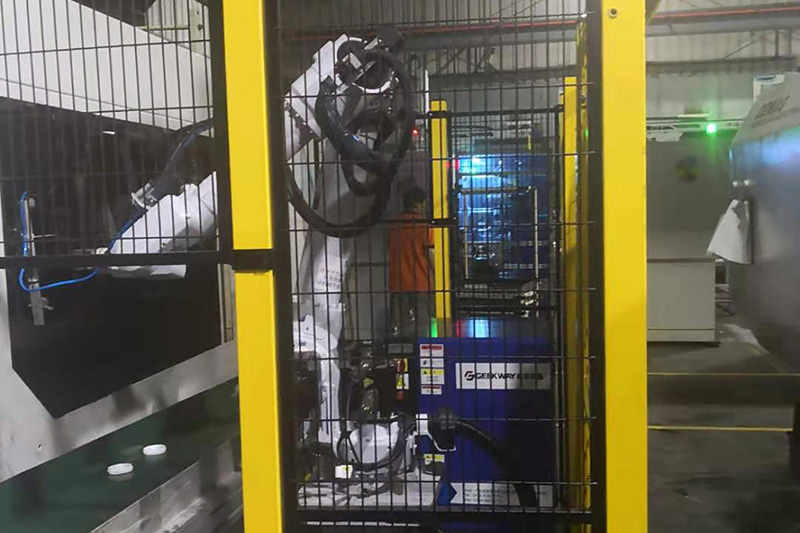
1. Clarify application requirements
Workpiece parameters: weight, size (maximum/minimum), shape complexity (whether multi angle grasping is required).
Production cycle time: The number of cycles per hour (such as 300 times/hour) determines the speed requirements of the robotic arm.
Die casting machine model: matching the die casting machine's opening stroke, top pin position, and tonnage (such as a 600T die casting machine that requires a larger load mechanical arm).
2. Core performance indicators
Load capacity: It needs to cover the weight of the workpiece+the weight of the fixture (usually with an additional 20% margin reserved). For example, if the workpiece weighs 5kg, select a machine model with a load ≥ 6kg.
Repetitive positioning accuracy: Die casting blanks usually require ± 0.1mm~± 0.5mm, and precision machining scenarios require higher accuracy (± 0.05mm).
Travel range: covering the distance from the die-casting machine cavity to the cooling/post-processing station, including the Z-axis pick-up height.
3. High temperature resistance and protective design
Temperature resistance level: Fixtures and end effectors need to withstand temperatures ranging from 200 ℃ to 400 ℃ (such as aluminum/magnesium alloy die-casting mold temperature). Optional water-cooled fixtures, high-temperature resistant silicone or ceramic coatings.
Protective measures: Anti splash: Metal liquid protective cover (stainless steel or heat-resistant alloy).
Dust prevention: IP54 or above protection level, key components are sealed (such as guide rails and cylinders).
Impact resistance: Strengthen structural design to avoid the impact of mold vibration on accuracy.
4. Drive and control system
Drive mode: servo electric: high-precision, easy to maintain, suitable for precision die-casting (such as automotive structural components).
Pneumatic: Low cost, fast pace, suitable for simple component extraction (small low-pressure casting).
Hydraulic: High load (>50kg), but complex maintenance, gradually replaced by electric.
Control function: It needs to support linkage with the die-casting machine (such as PLC communication, I/O signal interaction). Optional force control sensor to prevent mold jamming or workpiece damage.
5. End effector (fixture) design
Clamping method: Pneumatic gripper: Strong universality, suitable for regular shapes.
Vacuum suction cup: suitable for flat surfaces (such as die-casting panels), but requires high-temperature resistant materials (such as silicone and metal mesh).
Customized fixtures: Irregular parts require imitation design (such as engine cylinder block fixtures).
Quick mold change: modular design, supporting automatic switching of fixtures (for multi variety production scenarios).
6. Reliability and Maintenance
Durability: Key components such as reducers and guide rails require a long lifespan design (≥ 1 million cycles). The lubrication system needs to adapt to high-temperature environments (such as high-temperature grease or self-lubricating bearings).
Convenience of maintenance: The protective cover features a quick detachable design, making it easy to clean flying edges and dust.
7. Safety and Compliance
Safety protection: emergency stop button, collision detection, area grating (compliant with ISO 10218 standard). Isolation cover to prevent splashing of molten metal.
Environmental requirements: No oil leakage (to avoid contaminating castings), low-noise design.
Example of selection process
Requirement confirmed: 6kg workpiece, 800T die-casting machine, cycle rate of 200 times/hour, mold temperature of 300 ℃.
Initial selection parameters: load ≥ 8kg, repeatability ± 0.2mm, Z-axis stroke ≥ 1.5m.
Environmental adaptation: Choose servo electric+water-cooled fixtures, IP55 protection.
Verify compatibility: Check the interface of the die-casting machine (such as Profinet communication).
Test verification: Conduct actual component testing to ensure splash prevention and high temperature stability.
